
Ghost networks are quietly breaking the American healthcare system. A patient calls a therapist listed in their insurance directory, and the number is disconnected. A diabetic searches for an in-network endocrinologist and finds a clinic that closed two years ago. This happens because healthcare data goes stale faster than insurers can update it. Analysts are now turning to POI data to map exactly where these gaps in healthcare provider data show up across the country, and where real, operating providers actually sit on the ground.
The post explains why this issue continues. Why healthcare data is still failing patients. It shows how point-of-interest signals can restore trust in provider directories and the medical datasets underlying them.
What is a Ghost Network in Healthcare Provider Data?
Ghost networks refer to inaccurate provider directories. A listed healthcare professional may no longer be reachable, participate in the plan, or accept new patients. The entry is there, but the access it offers is not.
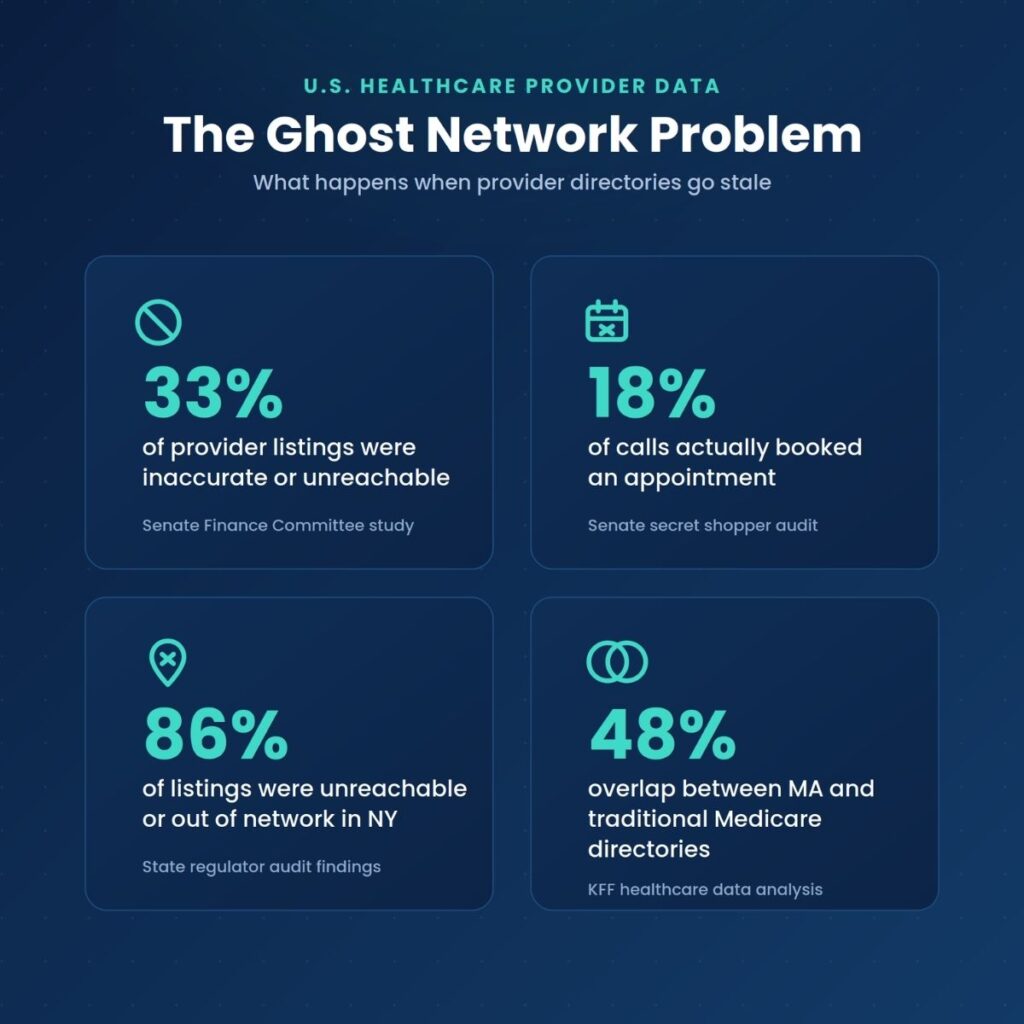
A Senate Finance Committee secret shopper study involved contacting 120 mental health providers across 12 health plans in six states to assess access to care. It found that:
- Staff could book an appointment only 18% of the time.
- 33% of the listings were inaccurate or had non-working numbers that were not returned
A comparable audit carried out in New York discovered that 86% of the listings were unreachable, outside the network, or not accepting new patients.
The Yale Law & Policy Review describes ghost networks as a harmful aspect of the American healthcare system. The studies have found that over half of all entries in the directory contain errors, such as:
- incorrect addresses,
- obsolete phone numbers,
- providers who had never joined a plan.
This makes the healthcare provider information that patients rely on completely unreliable.
Why Healthcare Data Keeps Falling Out of Date
This rarely happens because insurers intend to mislead people. It happens because health datasets change constantly. Only a few teams have a system built to track that change in real time.
A few everyday shifts that cause this decay:
- Doctors change practices,
- Clinics either merge or close,
- Contracts expire without anyone updating the public listings.
A study by KFF found that Medicare Advantage plans list only 48% of the doctors who accept traditional Medicare in their own directories, illustrating how quickly a healthcare provider network can fall out of sync with reality.
When Outdated Data Becomes a Patient Access Problem
The impact goes beyond just treating it as an inconvenience. HealthLeaders Media points out that:
- When members cannot find an available provider, manageable conditions can turn into acute ones. The damage is especially severe for people seeking mental health care.
- Inaccurate directories result in more calls to costly customer service channels and lead to unexpected out-of-network claims.
The regulators are reacting. According to HealthLeaders, Medicare Advantage plans now have to submit their directories to CMS for inclusion in the Plan Finder tool. And also update them within 30 days of any change. This one rule illustrates just how vulnerable healthcare data has become. It now requires continuous verification rather than a yearly cleanup.
| Regulatory Watch: The CMS Directory Accuracy Clock Is Ticking. This year, CMS is testing a process that compares plan directory data with third-party sources. By 2027, plans will be fully responsible for their data. If the numbers do not match, plans may face corrective action, fines, or even limits on marketing and enrollment. If these issues happen this fall, more members will likely complain, and the accuracy of the main tool people use to choose plans during open enrollment will be questioned. |
How POI Data Exposes Gaps in the Healthcare Provider Network
This is where POI data changes the situation. Point of interest data refers to structured information on actual physical locations, such as name, category, address, coordinates, and whether they are open or closed. In the context of healthcare, it includes hospitals, urgent care centers, clinics, pharmacies, and individual practices. It is verified against the physical world rather than relying on a form completed years ago by an insurer.
Instead of depending on the information in a directory listing, teams can compare two very different types of data. On one side are the clinical records. The NPI registrations, the provider’s claims history, filings with the licensing board, and the paper trail that shows that the provider is credentialed and active.
The other part is made up of real-world signals where three questions matter most:
- Is the facility still at that existing address?
- Is the facility open within the hours stated?
- Or has the facility shifted to another location, shut down, or been acquired by anyother organisation?
When clinical records say “active,” real‑world signals disagree; that is exactly the type of problem that point‑of‑interest data can identify. It can do this times faster than a manual audit.
Healthcare systems have already applied this method for catchment area analysis. It involves comparing confirmed facility locations with population data in order to identify areas that are underserved. Where accurate location information is combined with demographic data, a simple list of clinics then turns into a practical map showing where care is actually lacking.
Mobius creates this type of verified location base by running regular accuracy checks on millions of physical locations. This same method is used for healthcare provider data. It identifies entries that no longer match what is actually on the ground.
Turning Location Signals Into Reliable Healthcare Datasets
Reliable healthcare datasets do not appear on their own. They need a defined process to collect, verify, and refresh information about every provider and facility in a network. Teams that treat health datasets as a one-time deliverable end up right back where they started. Chasing complaints instead of preventing them.
The Data Workflow Framework
1. Triangulation of sources:
Do not rely on one self‑reported source. Obtain records from the claims data from the licensing boards and from the verified location signals. Then check these records against one another. If a provider appears in the claims data but not in the location data, or if a provider appears in the location data but not in the claims data, this should be treated as a flag that’s worth investigating before the member does.
2. Field Verification:
When carrying out field verification, check the addresses and phone numbers. Verify whether the clinic is still open by referring to up-to-date location signals. Do not rely solely on the information entered when the record was originally created. This step identifies the clinic that had moved quietly eight months earlier but never informed the health plan.
3. Real-time flagging:
This means that if a facility closes, moves, or changes its specialty, this should become apparent immediately, not only many months later as a result of a planned audit. It is precisely between the moment the change takes place and the moment it is noticed that ghost networks come about.
4. Standardization:
It is important to make sure provider names and addresses are the same so that the same clinic is not listed more than once in different ways. If this is not done, the data might look wrong even if the basic information is correct. The list might seem big or not match up properly.
It is at this point that medical datasets and location signals begin to overlap. The hospital’s location and hours of operation are pulled from vetted location data. The doctor’s specialty and network status are pulled from claims and credentialing sources. When both types of data are combined, the resulting information about healthcare providers shows what is currently happening, rather than reflecting the situation at the time the record was originally entered.
Mobius deals with this issue by means of its various data quality services. We continuously profile, standardize, and validate large datasets rather than viewing accuracy as something that should be dealt with once and for all. When these services are applied to provider directories, they identify a closed clinic before it turns into another complaint about a ghost network.
How to Build Healthcare Access Maps from Medical Datasets
Turning verified medical datasets into an access map doesn’t require a large research team. What matters is having a practical, consistent process that turns raw healthcare data into useful insights.
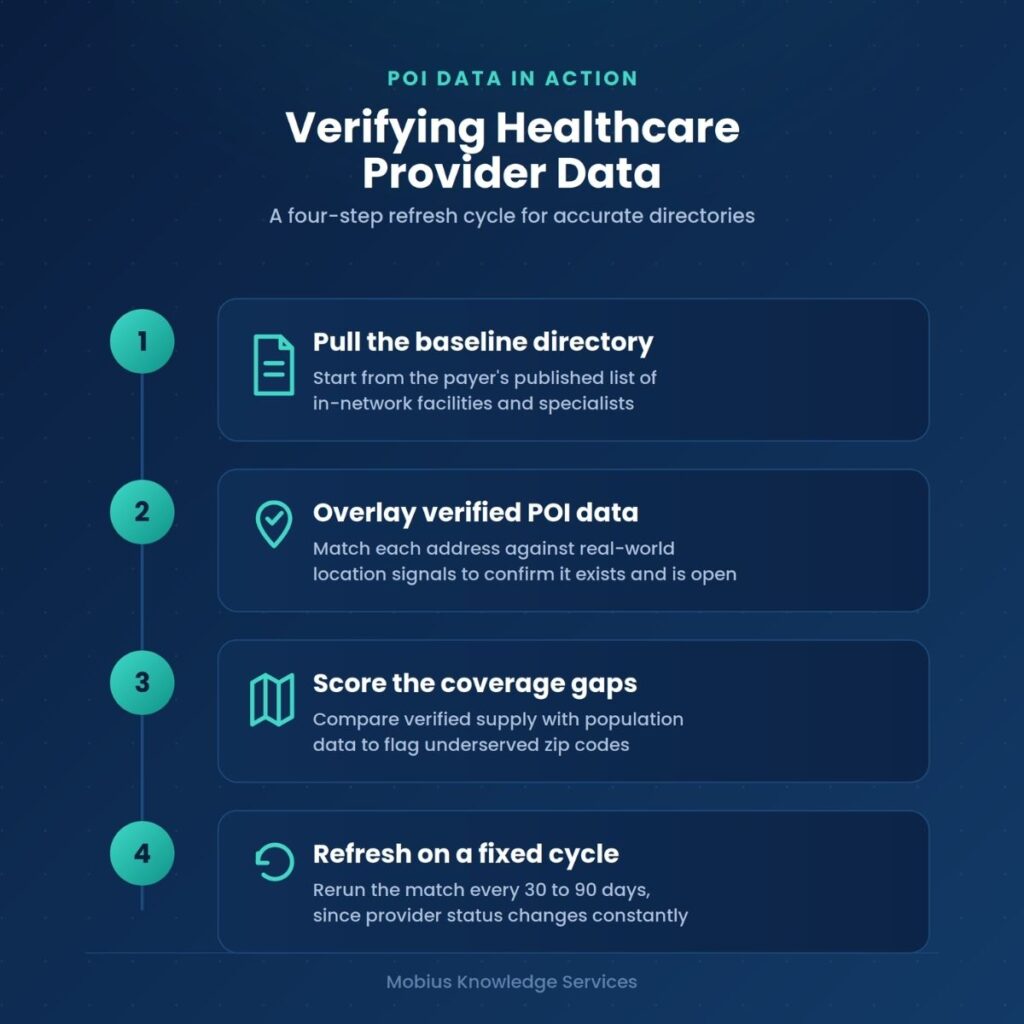
- Start with the baseline directory. Begin with the payer’s published list of in-network healthcare facilities and specialists.
- Overlay the POI data by matching each address with the verified point-of-interest records to make sure that the facility exists, is open, and corresponds to the category listed.
- Include population data and add information about census tracts as well as the known rate of chronic diseases to identify the areas with the highest demand.
- Identify the gaps in coverage of services. For each specialty, compute the drive-time access and then mark the zip codes in which the verified supply is less than the demand.
- Refresh on a cycle; repeat the match every 30 to 90 days since provider status is constantly changing.
Turn Healthcare Data Into a Living Access Map
Our guide to understanding point of interest data walks through how location attributes like category and freshness get captured and refreshed at scale. That same refresh discipline keeps a healthcare provider network map from going stale within weeks of publication.
If it is applied consistently, the framework will transform healthcare data from a static compliance document into a dynamic tool. Health systems can use it to plan where to locate new clinics. Advocacy groups can use it to show regulators where access gaps exist. Payers can use it to detect inaccuracies before a member picks up the phone.
It won’t function unless there is a mutual commitment to keeping healthcare data up to date. A single cleanup exercise may appear accurate on the day it is launched. But it will start to deteriorate within weeks. Providers retire, move house, and change specialties according to their own schedule, not the health plan’s audit schedule.
The Regulatory Push Behind Better Healthcare Data
The government’s examination of these directory failures is becoming more intense. This increased pressure is causing the plans to adopt better data practices.
Axios report said that a lawsuit against Anthem Blue Cross and Blue Shield arrived as Congress and the White House stepped up efforts to force insurers to report which providers are in-network accurately. HealthLeaders adds that CMS has revived the idea of a national provider directory. It could reshape how the healthcare ecosystem manages provider information if it is executed well.
The point made by the Yale Law & Policy Review regarding state enforcement is similar to this one. Even after many years of trying to regulate them. The current directory accuracy rules have mostly been unable to resolve the issue. It is precisely this gap between rules and actual outcomes that makes independently verified healthcare data important. Regulators can set requirements. But only continuously updated data on locations and providers can verify whether a plan is actually in compliance.
For health plans, hospital systems, and health technology teams, the message is clear. It is not a strategy to wait until the next compliance deadline. What actually eliminates the gap between a printed directory and the provider a patient can contact on a Tuesday afternoon is the establishment of a repeatable process based on location intelligence and verified medical data.
Frequently Asked Questions (FAQs)
Ghost networks are directories offered by providers that give a list of doctors, therapists, or facilities that are, in reality, not reachable, not within the network, or not accepting new patients. Although such a list is available in print, the access it claims to provide is not actually available.
They are very common. Research by the Senate Finance Committee found that 33% of the provider listings checked were inaccurate or unreachable. Separate state-level audits found even higher failure rates for mental health listings.
It checks whether a healthcare facility actually exists at the listed address. It verifies whether the facility is open and whether its category matches the directory entry. Comparing the directories with these location records enables outdated or incorrect listings to be identified before patients use them.
Healthcare datasets are basically clinical, licensing, and claims information about a provider. Point-of-interest data covers a facility’s physical location, category, and operating status. Combining both produces more reliable healthcare provider data than either source alone.
Yes. Under the No Surprises Act, in-network provider directories must be updated by health plans every 90 days at minimum. CMS also makes it a requirement for Medicare Advantage plans to refresh entries within 30 days of any change. Updating directories helps patients find care, instead of running into out-of-date contacts.
Conclusion
These directory failures continue because healthcare provider data changes faster than most organizations can keep up with. The good news is that validated healthcare location data finally gives health plans, researchers, insurers, and policymakers a chance to get back in the field. Every team can make a stale, static healthcare directory into a living network. Combine fresh healthcare POI data with claims and licensing records. Help patients find healthcare services that are available today, not outdated listings.
Explore how Mobius helps organizations convert siloed healthcare data into validated, continuously refreshed health datasets. It bridgesexperiences the gap between what a directory reports and patients’ experience in reality.
Read AI-generated summary
- A patient calls a therapist listed in their insurance directory, and the number is disconnected.
- Analysts are now turning to POI data to map exactly where these gaps in healthcare provider data show up across the country, and where real, operating providers actually sit on the ground.
- A listed healthcare professional may no longer be reachable, participate in the plan, or accept new patients.
- A comparable audit carried out in New York discovered that 86% of the listings were unreachable, outside the network, or not accepting new patients.
- A study by KFF found that Medicare Advantage plans list only 48% of the doctors who accept traditional Medicare in their own directories, illustrating how quickly a healthcare provider network can fall out of sync with reality.