
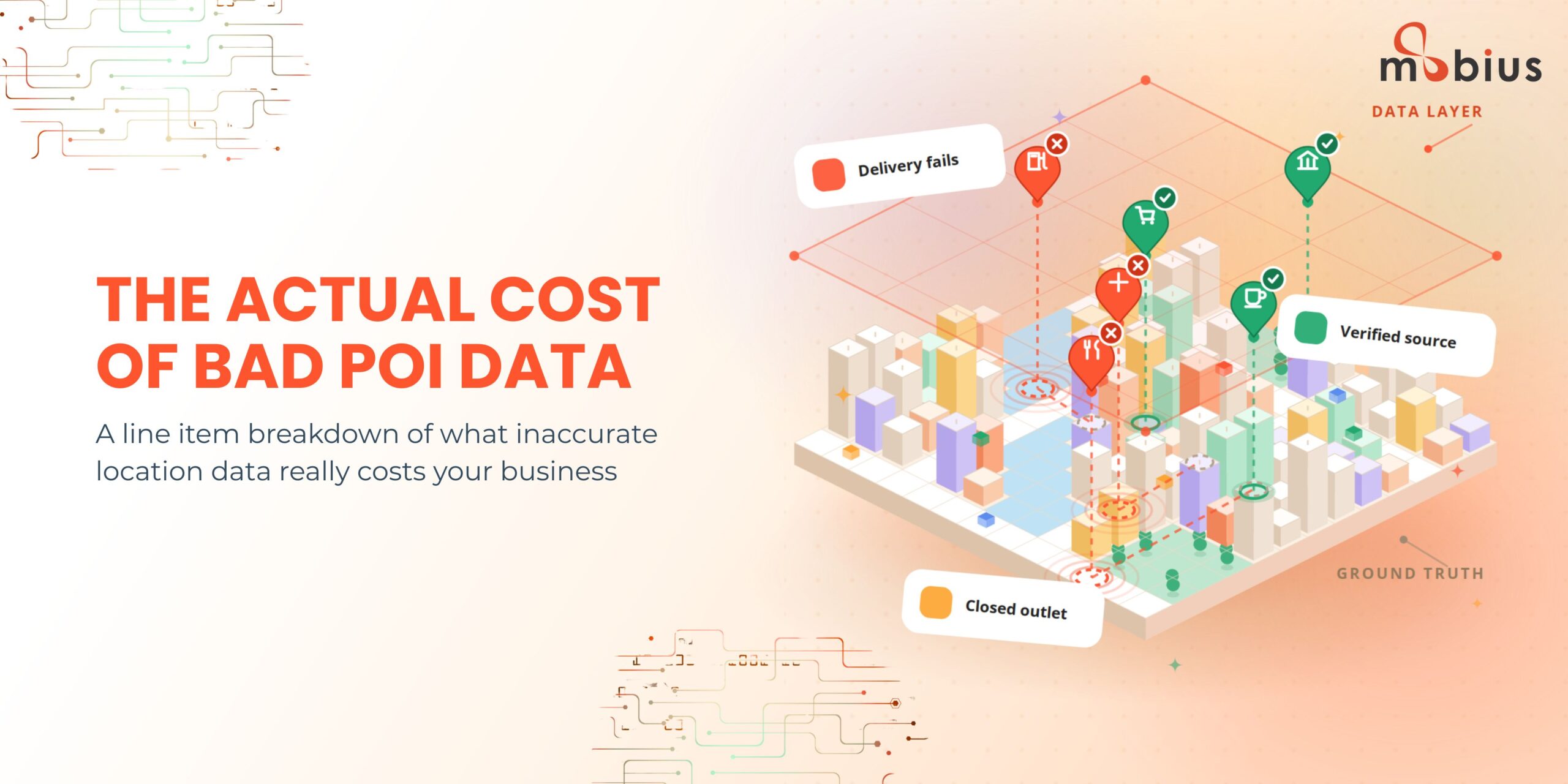
Most businesses treat Point of Interest (POI) data as a background amenity, an expensive misconception. But this data quietly influences some of the most important business decisions, such as where to deliver, where to advertise, and where to open the next store. When that data itself is wrong, these decisions are built on reasons that don’t actually exist, and the business rarely finds out the real cost of bad POI data.
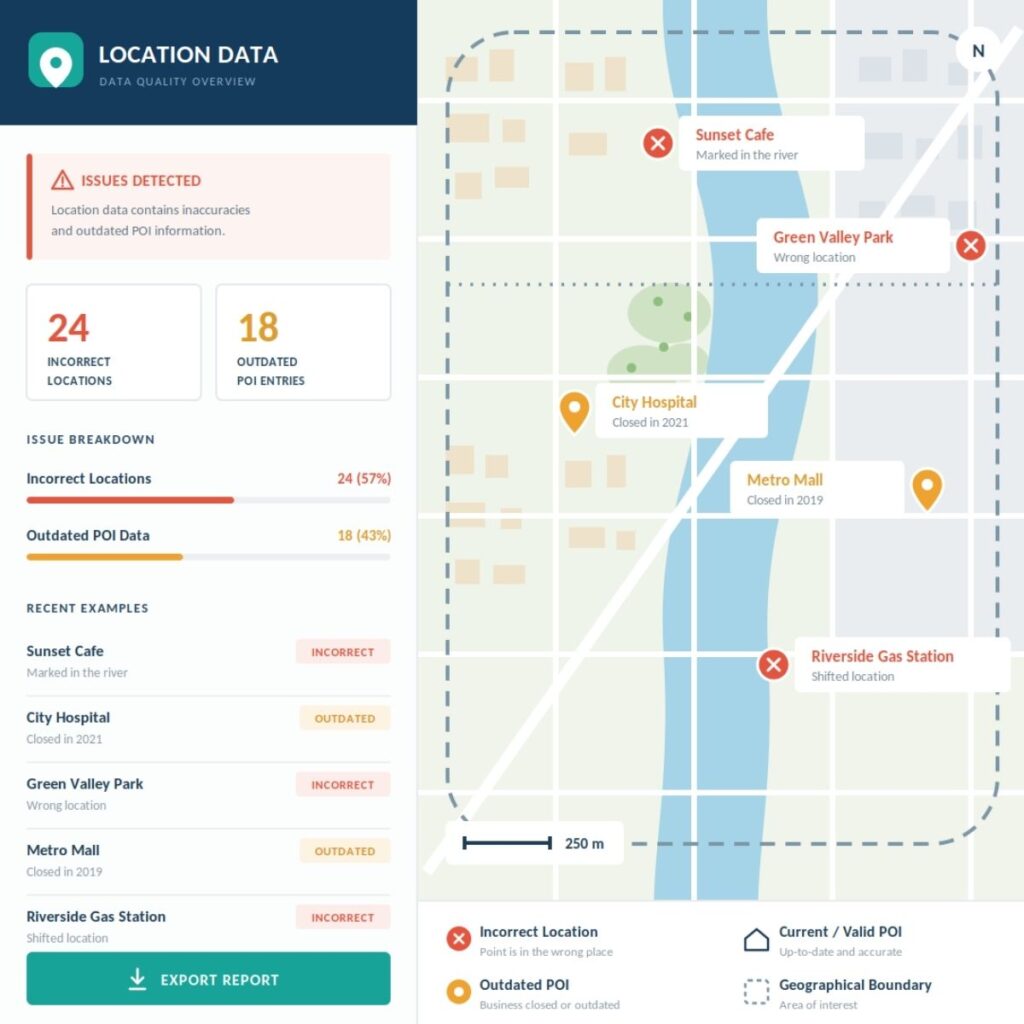
Bad POI data does not provide an error message or warning. It shows up without any noise. The problem becomes obvious when a delivery driver circles a block looking for a storefront that no longer exists. It happens when an ad impression is served to a business that was closed eight months ago. Or when a site selection data model is built on a competitor location that was never real.
One of the important, though often overlooked, contributors to these business inefficiencies is poor business location data. It touches marketing, logistics, and expansion planning all at once. This blog breaks down the line items behind the real cost of bad POI data and where the money is really going.
Wasted Ad Spend from Inaccurate POI Data
The True Cost of Poor Location Data in Digital Advertising
Location-based advertising depends entirely on the assumption that you have reliable Point of Interest data. This means the location is accurate, the business is active, and its category is correct. But what if the assumption fails? The ad budget doesn’t just underperform; it vanishes like dust.
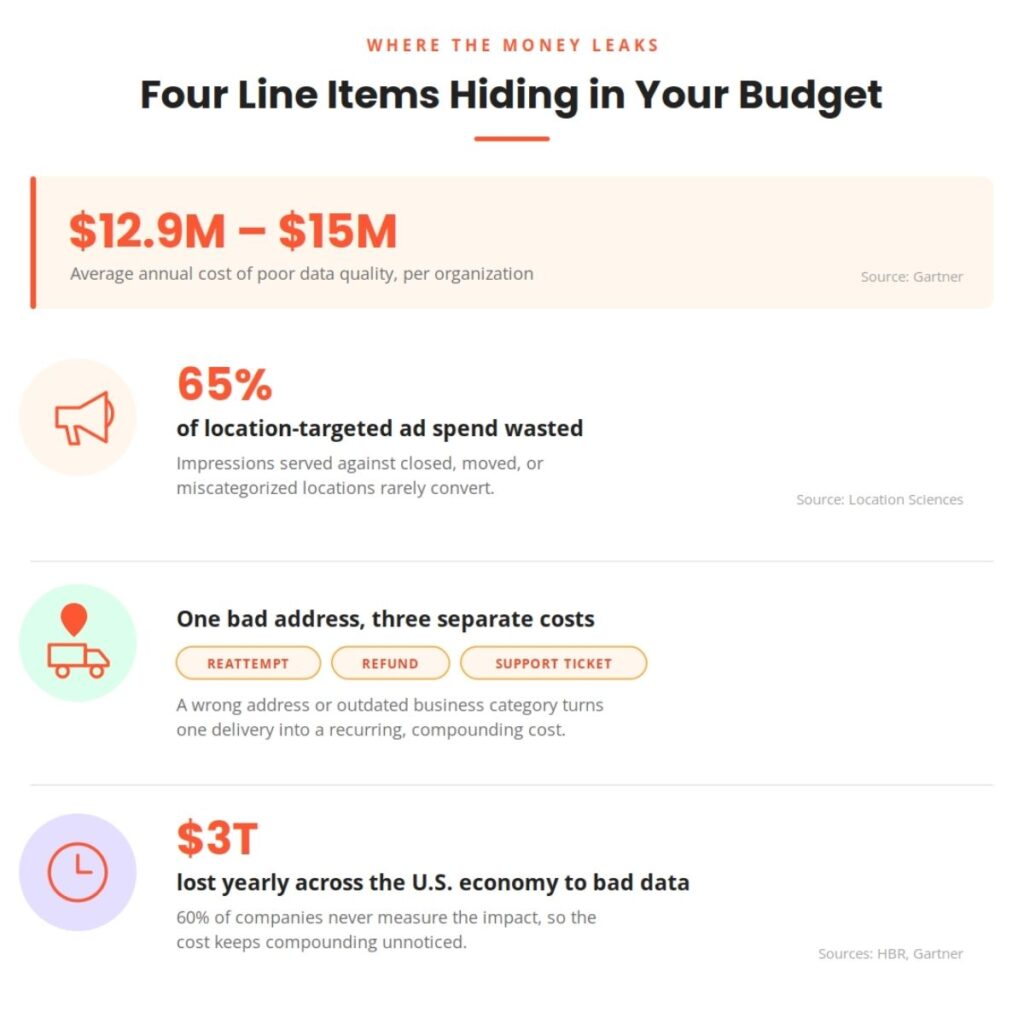
Industry research findings show that 65% of the money spent on location-targeted advertising is wasted. Of this waste, 29% comes from impressions delivered outside the intended geotargeted area, while 36% results from poor-quality location signals. Largely, this is due to inaccurate or negligent use of location data, according to a Location Sciences study covering half a billion ad impressions.
A retailer running geofenced campaigns to target shoppers near competing stores is a common conquesting tactic in retail media. If even a small percentage of those competitor locations are closed, relocated, or inaccurately mapped, the geofences are placed in the wrong locations.
Instead of reaching shoppers visiting competitor stores, the campaign targets the wrong audience and misses high-intent customers at the actual stores. In the long run, even small location data inaccuracies can result in tens of thousands of dollars in wasted advertising spend.
That’s why marketing teams increasingly incorporate POI data verification into the process before launching a campaign, rather than fixing it after a performance dip. Explore how correct POI data is revolutionizing the hyperlocal marketing segment to build no-waste ad campaigns.
How Poor POI Data Increases Delivery Delays and Higher Costs
Mis-Routed Deliveries and Last-Mile Failures
Last-mile logistics is where bad Point of Interest data does the most damage. Let’s say the address is wrong, the entrance is not marked correctly, or the type of business is not up to date. Any of these issues can cause a routine delivery to fail. Every unsuccessful delivery creates multiple costs. These include an additional delivery attempt, higher fuel consumption, more driver hours, customer support time, and, in many cases, refunds or discounts.
As failed delivery volumes increase, these costs multiply faster. A logistics network handling thousands of deliveries doesn’t need a high error rate to experience the impact. Even a small number of inaccurate POIs can greatly affect a large number of deliveries. Over time, those small errors become recurring costs that are rarely traced back to the underlying bad POI data. It gets logged as a delivery exception or delay instead of a data quality problem, which is exactly why it never gets fixed.
Retailers and delivery networks that understand the cause and effect know that better POI data contributes to better outcomes. Therefore, instead of changing the routing algorithm altogether, correcting business location data at the source often reduces reattempts more effectively.
The Cost of Failed Site Selection Decisions
A single bad location decision can cost years of growth.
Site selection data is one of the highest-stakes use cases for POI data. It is also one of the least forgiving when that data is wrong. An expansion strategy for a retail store can only work when the data used is accurate. If it uses inaccurate competitor location data, customer demand estimates, or category tags, the site selection data becomes unreliable. This can lead to flawed decisions. In some cases, it can point a firm toward the wrong market entirely.
“A single mis-sited store, warehouse, or distribution hub built on inconsistent POI data can cost a company years of underperformance before the real cause is even identified.”
For instance, a grocery chain planning to expand into a new neighborhood is relying on business location data from a site selection model showing three active competitors nearby. But it turns out that the POI dataset was never updated, and two of those competitors closed months earlier. In this case, the actual competitive landscape is completely the opposite of the report’s suggestion.
Hence, the new store opens on a flawed assumption about a market far more saturated than projected, and customer visits never reach the levels in the original business case. Over the following quarter, the retailer might adjust staffing, marketing, and pricing strategies to improve performance. But they may not realize that the site selection data used was outdated.
This is the category of cost that rarely shows up on a spreadsheet labeled “data quality.” It shows up as underperforming stores, missed revenue targets, inefficient marketing spend, delayed ROI, or even costly real estate write-offs and abandoned expansion plans.
When POI data is inaccurate, the impact extends far beyond the dataset itself, influencing business decision-making and potentially impacting performance for years.
To see how verified POI datasets support smart market entry decisions, explore how accurate POI data improves site selection strategies.
The Compounding Cost of Data Decay
Outdated POI data quietly erodes business performance over time.
None of these costs is a one-time event. Point of Interest data decays continuously. Businesses close, relocate, change hours, and rebrand every single day, and a dataset that was accurate six months ago is not guaranteed to be accurate now.
Harvard Business Review has estimated that bad data broadly drains as much as 3 trillion dollars annually from the U.S. economy. Location data’s constant rate of change makes it one of the faster-decaying categories within that figure.
This data decay carries a real price tag at the business level, too. A report from Gartner estimates that poor data quality costs an average organization around $12.9M to $15M every year. These costs stem from wasted resources, inefficiencies, and missed business opportunities.
Yet these losses are rarely traced back to their source, which is part of the problem. For many businesses, location data is exactly where the trail leads. POI accuracy touches nearly every revenue-generating function, from advertising and logistics to site selection and real estate planning.
Roughly 60% of companies do not measure the financial impact of poor data quality at all, according to Gartner’s research. Hence, these costs accumulate without anyone assigning them to a budget line.
Continuous POI data verification, rather than periodic cleanup, is the only way to keep up with quickly changing real-world locations. It also helps prevent hidden costs from compounding over time.
How to Calculate Your Own POI Data ROI
A simple approach to quantify the return on accurate POI data.
Most of the costs above stay invisible because no one owns the number, and the cost of bad POI data stays hidden until someone finally adds it up. Ad spend waste sits with marketing, delivery reattempts sit with logistics, and site selection errors sit with real estate. None of those teams sees the full picture, so the opportunity for fixing it never comes. Calculating POI data ROI is really just a matter of pulling those line items into one place.
Start with three questions for each department that touches location data:
- How much budget depends on a POI being accurate right now, and not at the time it was first entered into the system?
- What does one mistake cost, whether it is a wasted ad, a failed delivery, or a wrong address? How often does that mistake happen?
- How would those costs change if you verified the underlying data on a rolling basis instead of checking it once a year or never?
Multiply the failure cost by frequency, and you get an annualized number for each category. Add the categories together, and you get a working estimate of the overall cost of bad POI data for your business.
The Business Value of Verified POI Data
Wasted ad spend, delivery reattempts, flawed site selection, and ongoing data decay are not separate problems. They are indicators of one single problem: using incorrect or outdated POI data to make business decisions. Companies that keep their location data up to date, rather than treating it as a static one-time task, are the ones that stop paying the hidden cost of bad POI data quarter after quarter.
If you want to see what this looks like for your own operation, our team can walk you through a free POI data audit. We’ll show you exactly where inaccurate location data is costing your business today. You can also explore our POI data solutions to see how continuously updated data can improve your existing data.
Frequently Asked Questions (FAQs)
POI stands for Point of Interest. This type of data includes information about real-world places such as stores, restaurants, offices, hospitals, and other locations people visit. It usually includes the business name, address, category, coordinates, hours, and whether the place is open, closed, or has moved. Businesses use POI data for applications such as maps, navigation, delivery routes, location-based advertising, market analysis, and site selection.
Poor data quality costs an average organization between $12.9 million and $15 million every year, according to Gartner; for businesses that depend on location data, wasted ad spend, failed deliveries, and flawed site selection are among the biggest contributors to that figure.
Location-based advertising depends on knowing that a business is open, active, and correctly categorized. When that data itself is wrong, ads get served to closed or mismatched locations. Industry research shows that up to 65 percent of location-targeted ad spend is wasted this way.
POI data should be verified on a continuous or rolling basis rather than checked once a year. Businesses close, relocate, and rebrand every day, so a dataset that was accurate six months ago is not guaranteed to be accurate today.
Yes. Site selection models rely on accurate competitor locations and customer demand data. When that data is outdated, a new store or warehouse can be planned around a market that no longer looks the way the data suggested it would, leading to years of underperformance before the cause is identified.
POI data ROI is calculated by multiplying the cost of a single data-driven mistake, such as a wasted ad impression or a failed delivery, by how often that mistake happens, then adding the totals across every department that touches location data. The result is a working estimate of what bad POI data is actually costing the business each year.
Read AI-generated summary
- When that data itself is wrong, these decisions are built on reasons that don’t actually exist, and the business rarely finds out the real cost of bad POI data.
- Or when a site selection data model is built on a competitor location that was never real.
- In the long run, even small location data inaccuracies can result in tens of thousands of dollars in wasted advertising spend.
- Let’s say the address is wrong, the entrance is not marked correctly, or the type of business is not up to date.
- It gets logged as a delivery exception or delay instead of a data quality problem, which is exactly why it never gets fixed.