Enterprises have never had more data available, yet many still struggle to turn their corporate data into decisions that drive growth.
Some organizations invest heavily in AI platforms and CRM systems, but continue to rely on incomplete or outdated corporate data. They are drowning in raw data, yet completely starved for actionable insights.
The challenge isn’t a lack of information. It’s that markets now evolve faster than internal systems can keep up. Buyers research anonymously, decision-makers change roles, companies expand into new markets, and competitive dynamics shift constantly. In this environment, relying solely on CRM records or historical customer data is no longer enough. Enterprises need continuous visibility into what’s happening beyond their own databases.
Most revenue gaps don’t begin with strategy; they begin with execution. Organizations in the same industry often have access to similar technology, talent, and market opportunities, yet consistently achieve very different outcomes.
The difference? One closed its enterprise data intelligence gap. The other didn’t even know it existed.
In this blog, we’ll explore why corporate data intelligence is now a core business capability, how it transforms fragmented market data into strategic insight, and why enterprises that build this foundation are better positioned to accelerate growth, improve decision-making, and stay ahead of the competition.
What is the enterprise intelligence gap?
The enterprise data intelligence gap is the dangerous chasm between the data an organization collects and the actionable insights it actually uses to drive decisions. In an era flooded with business intelligence tools, real-time analytics dashboards, and cloud data warehouses, it might seem like this gap should be shrinking. In most organizations, it’s growing.
According to a FullStory survey, companies use less than 25% of the data available to them because much of it lacks the quality, structure, or context needed for informed decision-making. As a result, it remains fragmented across departments, trapped in legacy systems, or buried in unstructured formats that organizations struggle to interpret at scale. This is the intelligence gap, and it’s costing enterprises billions in missed opportunities, operational inefficiency, and strategic missteps.
Why corporate data intelligence is becoming a necessity
We’ve moved past the era where having a basic CRM or a static lead list was enough to get by. Today, that’s just table stakes. What separates market leaders from laggards is corporate data intelligence, the capability to continuously inject high-accuracy, real-time external insights directly into your go-to-market engine.
Think about what modern B2B data from revenue teams demands in real time:
- Finding buyers before they reach out
Identify high-value accounts that are actively researching your product category long before they submit a contact form or engage with sales. - Keeping customer data accurate and actionable
Continuously enrich CRM records with a reliable company information database, including revenue, technology stacks, and growth indicators. - Connecting with the right decision-makers
Reach verified executives directly through accurate contact information, reducing delays and improving outreach effectiveness. - Expanding beyond your existing market view
Uncover high-fit accounts outside your current database to reveal new opportunities and drive sustainable pipeline growth.
This isn’t a technology wish list. It’s the baseline expectation of a modern enterprise. Without premium, externally sourced intelligence, your sales and marketing teams are making million-dollar outreach decisions using stale information, dead phone numbers, or worse—blind instinct.
The hidden cost of “intelligence debt”
Most executives are well aware of technical debt. Far fewer recognize intelligence debt, the compounding cost of relying on stale, unverified, or fragmented B2B data to run your go-to-market engine.
Intelligence debt compounds silently. When an enterprise delays investing in a premium, real-time data solution, they aren’t just missing out on a few phone numbers. They are being consistently outpaced by competitors who are hitting the market with laser-precise account data.
Every month you delay, your intelligence debt grows:
- Your sales pipeline starves because reps are wasting time prospecting out-of-business accounts or calling disconnected numbers.
- Your marketing spend is wasted because campaigns are targeting executive titles that changed six months ago.
- Your outreach strategy becomes reactive because you can’t see which accounts are actively showing buying intent right now.
The ROI of premium company intelligence is notoriously hard to quantify upfront, which is precisely why so many organizations keep deferring it, sticking instead to cheap, static lead lists. But the cost of this neglect is written clearly in the outcomes: sluggish go-to-market velocity, skyrocketing customer acquisition costs (CAC), and sales leadership flying blind during the pipeline reviews that matter most.
Where the gap lives: The four fault lines
Closing the enterprise data intelligence gap requires understanding exactly where your pipeline is leaking. In most B2B data across organizations, the breakdown happens across four distinct fault lines:
1. Data decay and fragmentation
Your CRM is filled with accounts, but that data is steadily becoming outdated. Executives change jobs, companies scale or downsize, and tech stacks shift. When your internal records don’t talk to a real-time external intelligence engine, your sales and marketing teams end up operating in a bubble, targeting companies that no longer fit your ideal customer profile (ICP).
2. Volume over veracity
Many organizations buy massive, cheap lead lists to hit a “volume” metric, treating data acquisition as a compliance exercise rather than a strategic enabler. But thousands of unverified emails and generic corporate switchboard numbers are just organized noise. Without deep, hand-verified account intelligence, you are simply automating inefficiency at scale.
3. The “detective” tax on talent
Organizations hire elite, highly paid account executives and SDRs, but force them to spend half their week playing data detective. When reps have to manually hunt for direct dials, verify titles on LinkedIn, or guess at corporate hierarchies, you have a severe talent-tool mismatch. Your team shouldn’t be searching for data; the data should be powering their outreach.
4. Insight without context (Missing intent)
Perhaps the most insidious gap: targeting the right account at the absolute wrong time. You might have a list of perfect-fit companies, but if you don’t have real-time intent signals showing who is actively researching your solution right now, you are flying blind. A great prospect list without real-time buying context results in missed timing and wasted pipeline velocity.
The architecture of intelligent enterprises
By replacing guesswork with precision, this intelligence architecture transforms fragmented market data into actionable intelligence that supports revenue generation. It ensures your GTM teams are always pitching the right decision-makers at the exact moment they are ready to buy, allowing companies to improve conversion rates and sales efficiency.
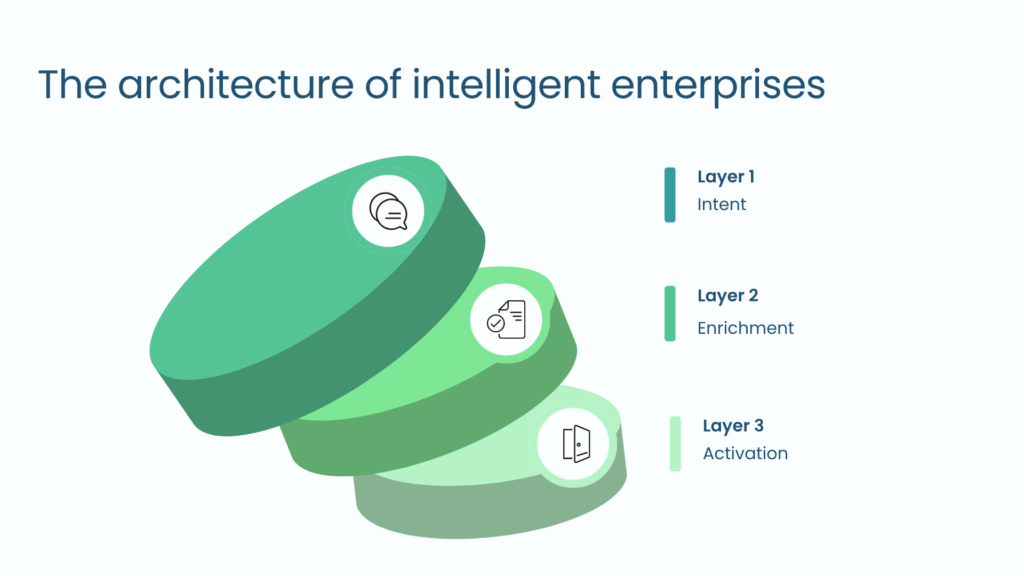
Layer 1: Intent
Every winning sales motion begins with knowing who is ready to buy. This layer continuously identifies in-market accounts and prioritizes opportunities based on real buying intent, ensuring GTM teams focus on prospects with the highest likelihood of conversion.
Layer 2: Enrichment
Intent alone isn’t enough. This layer transforms every opportunity into a complete customer profile by enriching accounts with company intelligence, organizational context, buying committee insights, and verified contact data—giving every team the confidence to engage the right stakeholders.
Layer 3: Activation
Intelligence creates value only when it drives action. This layer delivers enriched insights directly into GTM workflows, enabling marketing to target with precision, sales to engage faster, and RevOps to optimize pipeline performance with real-time, data-driven decision-making.
The window is narrowing
Here is the uncomfortable truth about the enterprise intelligence gap: the organizations that close it fastest are building compounding advantages that become impossible to overcome.
Every month that a competitor spends utilizing clean, real-time intent data and verified executive insights is another month they spend locking down key accounts, building deep buyer relationships, and refining their market positioning. Late movers who rely on outdated databases can never fully recover that lost pipeline.
Furthermore, advanced AI-driven sales platforms and agentic prospecting tools are dramatically accelerating this dynamic. Enterprises with mature, premium B2B data foundations are already deploying these advanced technologies to automate hyper-personalized outbound sequences, optimize ad targeting, and predict market shifts. Enterprises still wrestling with dirty, unverified data are watching from the sidelines.
The enterprise intelligence gap is real. It is widening. And in the hands of your competitors, it is becoming decisive.
Your competitors already know things you don’t
That’s not a hypothesis; it’s what the intelligence gap looks like from the losing side.
Mobius BizData is the corporate data intelligence platform built to put you back in the know. Like an always-on radar for the business world, it delivers continuously enriched, verified intelligence, firmographics, company profiles, contact data, ownership structures, and live market signals, so your sales, strategy, and operations teams are never making decisions in the dark.
No stale records. No blind spots. No guesswork.
Gain the precise market clarity required to win more deals, right at your fingertips. Contact our team now to see what your competitors already know.
Read AI-generated summary
- In this blog, we’ll explore why corporate data intelligence is now a core business capability, how it transforms fragmented market data into strategic insight, and why enterprises that build this foundation are better positioned to accelerate growth, improve decision-making, and stay ahead of the competition.
- The enterprise data intelligence gap is the dangerous chasm between the data an organization collects and the actionable insights it actually uses to drive decisions.
- According to a FullStory survey, companies use less than 25% of the data available to them because much of it lacks the quality, structure, or context needed for informed decision-making.
- It remains fragmented across departments, trapped in legacy systems, or buried in unstructured formats that organizations struggle to interpret at scale.
- When an enterprise delays investing in a premium, real-time data solution, they aren’t just missing out on a few phone numbers.