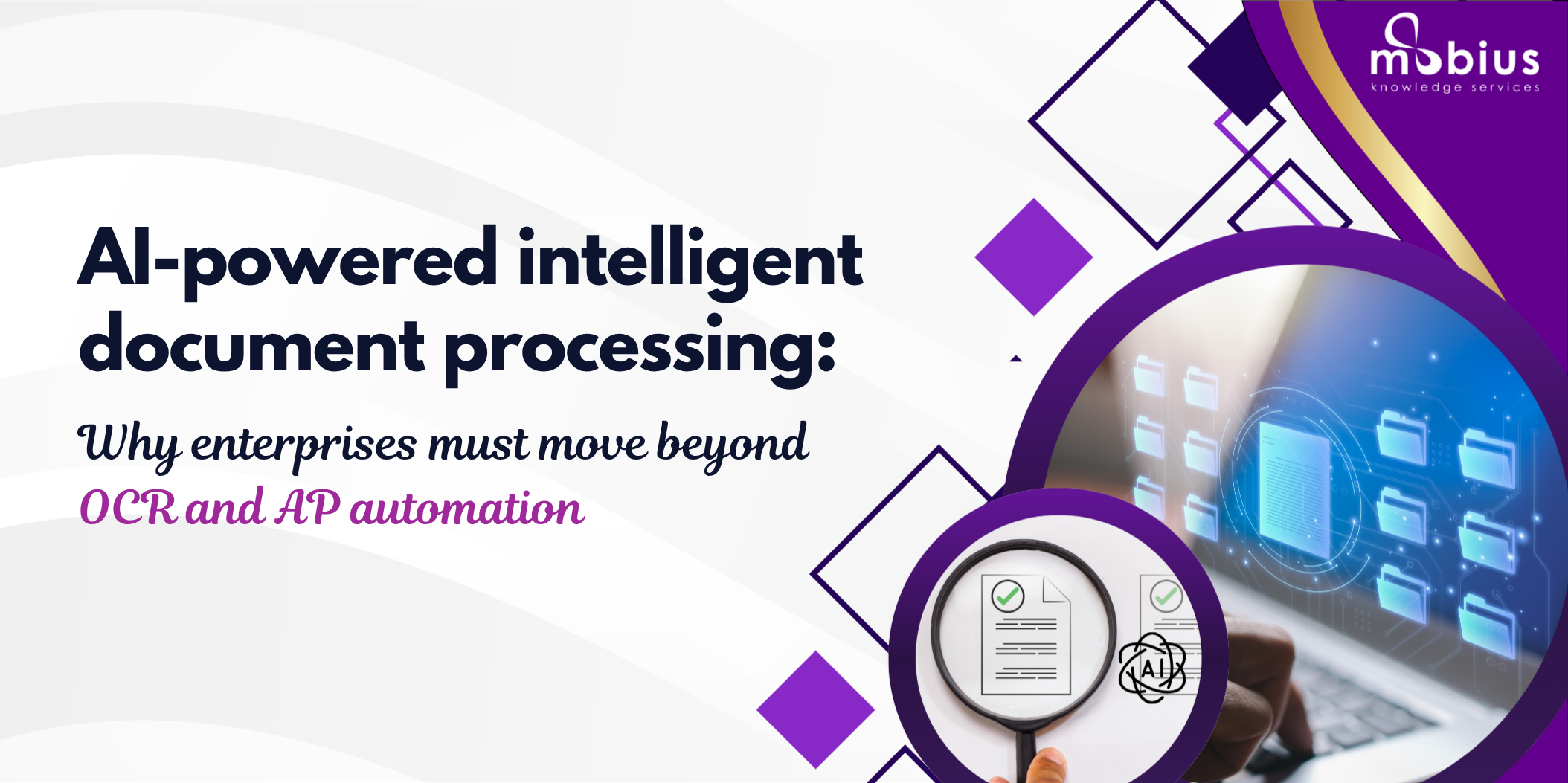
Documents may be digital, but the work behind them often isn’t. Teams still spend valuable hours extracting data, validating information, and entering it into business systems manually. With AI document processing, these tasks can be handled more efficiently.
Scanning paper records, using OCR to convert them into digital text, and automating repetitive workflows gave enterprises a significant productivity boost. Document intelligence took this progress further by enabling systems to understand and process information more intelligently, while intelligent document processing helps automate complex document-centric workflows with greater speed, accuracy, and consistency.
But the enterprise has changed considerably since then.
The modern organization is not constrained by a lack of information. They are struggling with too much information, spread across too many formats, systems, and processes.
Documents remain at the center of that challenge. Contracts, invoices, purchase orders, claims, financial records, customer communications, reports, forms, and operational documents continue to carry critical business information.
The challenge now goes beyond simply digitizing documents. What matters now is whether organizations can extract useful insights from their contents and use them effectively across large volumes of data.
That is where AI-powered document intelligence enters the picture.
From capturing information to understanding information.
OCR was never designed to understand a business. The system was designed to detect written characters and transform image-based content into machine-readable text. And it did that exceptionally well for its time. AP automation then added another layer by connecting extracted information to workflows such as matching, approval, and payment processing.
The limitation becomes apparent when we move beyond predictable documents and standardized processes.
Enterprise information is messy. Document formats change. Important details can be buried in paragraphs or tables. Information may be spread across multiple documents. Exceptions are common, and business rules don’t always fit neatly into predefined templates.
This is where AI-powered IDP changes the equation.
Instead of treating a document as a collection of fields, IDP can interpret it in context: classifying the document, identifying relevant information, understanding relationships, validating data, and routing it to the appropriate next step.
The shift is subtle in technology terms, but significant in business terms:
Why unstructured document processing is the next step beyond AP automation
AP remains an obvious starting point for automation because the business case is clear: high volumes, repetitive work, defined workflows, and measurable processing costs.
But an enterprise doesn’t run on invoices alone.
A typical organization has critical information flowing through:
- Procurement: purchase orders, supplier documents, quotations, and agreements
- Finance: invoices, statements, tax records, and financial documents
- Supply chain: shipping documents, delivery records, customs paperwork, and logistics records
- Legal: contracts, amendments, agreements, and supporting documentation
- Insurance: claims, policy documents, assessments, and supporting evidence
- Customer operations: emails, forms, applications, and attachments
- Compliance: regulatory documents, reports, certifications, and audit records
Automating AP can make finance more efficient. But unlocking information across these functions through unstructured document processing can have a much broader enterprise impact.
That is why IDP should not be viewed simply as the next version of invoice automation.
It is an opportunity to create a common document intelligence layer for document-heavy processes across the organization.
The Broader Business Value of IDP
Cost reduction remains one of the key factors supporting investment in IDP.
Reducing manual data entry, lowering exception-handling effort, and increasing processing throughput can deliver measurable operational benefits.
But for the C-suite, the bigger question is what happens beyond labor savings.
A well-designed IDP strategy can contribute to:
- Support growing workloads without proportionally expanding the workforce
- Faster cycle times across document-intensive processes
- Better data quality entering enterprise systems
- Improved visibility into information that was previously difficult to structure
- Greater consistency in repetitive decisions and workflows
- Reduced operational risk through validation and controlled processing
- Better employee productivity by shifting people away from repetitive review
- Stronger foundations for enterprise AI through access to structured, contextual data
This changes the investment conversation. IDP isn’t simply about making an existing process cheaper. It can help make the enterprise more scalable, responsive, and information-driven.
Traditional automation vs. AI-powered IDP: A smarter approach to exceptions
| Exception scenario | Traditional automation | AI-powered IDP |
| New document format | Often fails or requires manual reconfiguration. | Automatically adapts to new formats and identifies the right structure and fields. |
| Unexpected field | Misses the field or flags the document as an error. | Detects and extracts relevant information, even from unfamiliar fields. |
| Missing reference | May pass incomplete data or cause a process failure. | Identifies missing information, validates it against business rules, and routes it for the right action. |
| Unusual clause | Typically overlooked or requires manual review. | Uses AI to understand context, flag unusual language, and highlight potential risks or changes. |
| Discrepancy between two documents | May not detect the mismatch or requires complex rule setup. | Compares documents intelligently, identifies inconsistencies, and validates data with context. |
| Changed business rule | Continues using old rules until manually updated. | Applies updated rules automatically, reducing delays and errors. |
Combining AI efficiency with human expertise
The conversation around AI sometimes becomes unnecessarily binary: automation versus people. Enterprise operations are rarely that simple. The strongest model is often a combination of both. AI can take responsibility for high-volume and repetitive processing, while people provide judgment where ambiguity, risk, or business expertise is involved.
This creates a more practical operating model:
AI processes. Humans supervise. Experts decide where judgment matters.
For leadership teams, that can mean more than productivity improvement. It can change how skilled employees spend their working day.
Instead of reviewing hundreds of routine documents, they can focus on complex cases, customer issues, risk, compliance, and decisions that genuinely require experience.
Why generative AI alone isn’t enough without IDP
There is a larger strategic reason to move beyond conventional document automation.
Businesses are putting significant investment into technologies such as generative AI, copilots, intelligent assistants, and AI agents.
A significant amount of that information still lives in unstructured documents.
Contracts contain commercial commitments. Financial documents contain transactional information. Customer communications contain context. Reports contain operational knowledge.
If that information cannot be reliably extracted, structured, validated, and connected to business systems, the potential of enterprise AI remains constrained.
This is where IDP can play a key role in the wider AI architecture.
Think of it as a pathway:
Documents → AI understanding → Trusted information → Enterprise systems → Intelligent workflows
The value isn’t in simply feeding more documents into AI.
The value is in making enterprise information usable, reliable, and actionable.
What should leaders look for in an IDP strategy?
Technology selection should start with business objectives rather than a feature checklist.
Before investing, leadership teams should consider:
- Scale: Can the solution handle enterprise volumes without creating new operational bottlenecks?
- Breadth: Can it support multiple document types and business functions?
- Adaptability: Can it handle changing formats and previously unseen document structures?
- Accuracy: How reliable is the information being extracted and validated?
- Integration: Can it connect with ERP, CRM, workflow, and other enterprise platforms?
- Human oversight: Can people intervene intelligently when required?
- Governance: Can the organization maintain appropriate security, controls, and auditability?
- Business impact: Can success be measured through cycle time, straight-through processing, productivity, quality, and other meaningful KPIs?
- Future readiness: Can the platform support broader AI and automation initiatives rather than becoming another isolated technology stack?
These questions help shift IDP from a technology purchase to an enterprise transformation decision.
The competitive advantage is moving up the value chain
The first generation of document technology focused on capture. The next generation focused on automation. The emerging generation is focused on intelligence. That progression matters because value is moving further up the enterprise value chain.
Capturing information saves time. Automating processes saves effort. Understanding information can influence decisions and outcomes.
That is why the future of IDP will not be determined simply by who can extract the most fields from a document.
It will be determined by how effectively organizations can connect document intelligence with the processes, systems, and decisions that run the business.
The shift toward intelligent document operations
For enterprises, the next phase of document transformation is unlikely to be about replacing one OCR engine with another. It is about changing the role documents play in the organization.
- Instead of being passive records that employees retrieve and process, documents can become intelligent inputs into business operations.
- Instead of asking employees to manually interpret information, AI can do more of the initial understanding.
- Instead of routing every unusual case to an employee, intelligent systems can filter the workload and escalate only those situations that require human insight or judgment.
- And instead of keeping valuable information trapped in unstructured formats, organizations can turn it into data that powers workflows, analytics, automation, and AI.
That is a much bigger ambition than AP automation.
Your next business opportunity is hidden in your documents
The real opportunity with AI Document Processing is not the document itself. It is what the enterprise can do because it understands the document. That distinction is likely to become increasingly important as organizations look for new sources of operational efficiency while simultaneously preparing for an AI-driven future.
At Mobius, the focus is on helping enterprises turn complex and unstructured information into actionable business intelligence by combining AI-powered technologies, automation, process expertise, and human intelligence. The result is a more connected approach to AI document processing, one that goes beyond extraction and focuses on how information can support the wider business.
For enterprises ready to move beyond OCR and conventional AP automation, the next question isn’t simply “How can we process documents faster?”
It is:
“How can we make the intelligence inside our documents work for the business?”
The next step is moving beyond simply digitizing documents to making them truly usable. Intelligent Document Processing uses AI to extract, understand, and contextualize information at scale, helping enterprises reduce manual work and turn document-heavy processes into more efficient workflows.
Learn more about how Mobius Intelligent Document Processing can help put that intelligence to work across your enterprise.
Read AI-generated summary
- Document intelligence took this progress further by enabling systems to understand and process information more intelligently, while intelligent document processing helps automate complex document-centric workflows with greater speed, accuracy, and consistency.
- The modern organization is not constrained by a lack of information.
- Instead of treating a document as a collection of fields, IDP can interpret it in context.
- The shift is subtle in technology terms, but significant in business terms.
- It is an opportunity to create a common document intelligence layer for document-heavy processes across the organization.